
Maricopa County Property Tax is a yearly charge placed on real estate owners within Maricopa County, Arizona. It is collected through a county tax payment system that funds public services such as schools, roads, and emergency services. Maricopa County Property Tax refers to the amount paid by property owners based on the assessed value of land and buildings within county limits. It is managed through a structured county authority system that calculates rates, issues statements, and maintains official tax records for every parcel. The property billing process is based on valuation updates and local tax rates applied each year. These records help maintain transparency in ownership costs and tax responsibilities.
The tax payment system in Maricopa County allows property owners to pay dues through online platforms, mail, or authorized offices. Each payment is recorded in official tax records, which track history, balances, and updates linked to each property account. This system supports accurate billing, reduces errors in property tax statements, and keeps county revenue flow steady for public services.
What is Property Tax in Maricopa County?
Property tax in Maricopa County is a local tax collected on real estate such as homes, land, and commercial buildings. It funds public services that support daily life in the county. In simple terms, maricopa county az property tax is calculated based on property value and local tax rates. It is part of the wider system of Maricopa County, AZ, taxes that support schools, safety services, and infrastructure.
What property tax mean in Maricopa County, AZ
Property tax is a yearly charge placed on property ownership within Maricopa County. The tax applies to residential, commercial, and vacant land. It reflects the assessed value of each property. This tax system supports local government funding that keeps county operations active.
Collected money flows into public services funding, such as:
- Public schools and education programs
- Police and fire protection services
- Road maintenance and transportation projects
- Libraries and community facilities
The property tax system works as a shared responsibility model. Property owners contribute based on asset value.
Who manages the Maricopa County, AZ property tax
Two main offices handle the system:
- Maricopa County Assessor – sets and records property values
- Maricopa County Treasurer – collects tax payments and distributes funds
The assessor determines the taxable value using market data, property size, and location factors. The treasurer sends tax bills and manages payment records. This structure supports fair collection across all property ownership tax system categories in the county.
Property value and tax relationship
Property taxes rise or fall with assessed property value. Higher valued properties usually pay more in Maricopa County, AZ property tax. Lower valued properties pay less.
Factors that influence tax amounts include:
- Market price changes in local real estate
- Property improvements or expansions
- County and school district tax rates
This link between value and tax keeps Maricopa County, AZ, taxes aligned with local property conditions and funding needs.
How Property Taxes Are Calculated: Steps
Property taxes in Maricopa County come from a clear formula based on home value and local tax rates. The calculation uses assessed value, taxable value, and the county levy system to determine the final bill shown in property billing records. Each step connects valuation data with official tax records and tax rate calculation rules used by the county.
Assessed Value Explained
Assessed value starts the full property tax process. It comes from the county’s valuation process, where a home is evaluated based on market trends, size, location, and improvements. In Maricopa County, the assessed value is not the full market price. It is a reduced percentage of the market value. This becomes the taxable value, which is used for property billing and official tax records.
Factors used in this step:
- https://treasurer.maricopa.gov/

- Recent sales of similar homes
- Property size and structural condition
- Land value in the area
- Improvement upgrades or additions
For example, a home valued at $400,000 may have a lower assessed value after county adjustments. That adjusted figure becomes the base used in later tax rate calculation steps.
Tax Rate Formula Breakdown
The tax rate calculation combines several local rates set through the county levy system. These rates come from schools, city services, fire districts, and county operations.
The basic formula used is:
Property Tax = Taxable Value × Total Tax Rate
Tax rates are usually shown per $100 of assessed value. Each district adds its own portion to the final rate. When combined, they form the total tax rate applied to the property.
Common components inside the tax rate:
- County general fund rate
- School district rate
- City or town service rate
- Special district charges
For example, if the total tax rate is 1.2%, the homeowner pays that percentage of the taxable value. This number directly connects to property billing statements and official tax records maintained by the county.
Final Tax Calculation Example
A simple example shows how all parts work together in the Maricopa County property tax calculation.
Scenario:
- Home market value: $400,000
- Assessed value: $280,000
- Total tax rate: 1.2%
Step: calculation:
| Step | Calculation | Result |
|---|---|---|
| Start with taxable value | — | $280,000 |
| Apply tax rate | 280,000 × 0.012 | $3,360 annual tax |
The final amount appears in property billing statements sent by the county. This figure also becomes part of official tax records used for payment tracking and future adjustments.
Your Property Tax Bill Breakdown
Property tax bills in Maricopa County are split into clear categories tied to public services. Each line on the bill shows how Maricopa County, AZ, taxes fund schools, local services, and infrastructure through structured property billing. Each property tax bill in Maricopa County shows multiple charges grouped by public service type. These charges reflect tax allocation across school districts, county operations, city services, and special districts. This structure supports a clear government funding breakdown across the region.
School District Taxes
School district taxes form a large part of most property tax bills. These funds support local education systems and school facility operations.
Uses include:
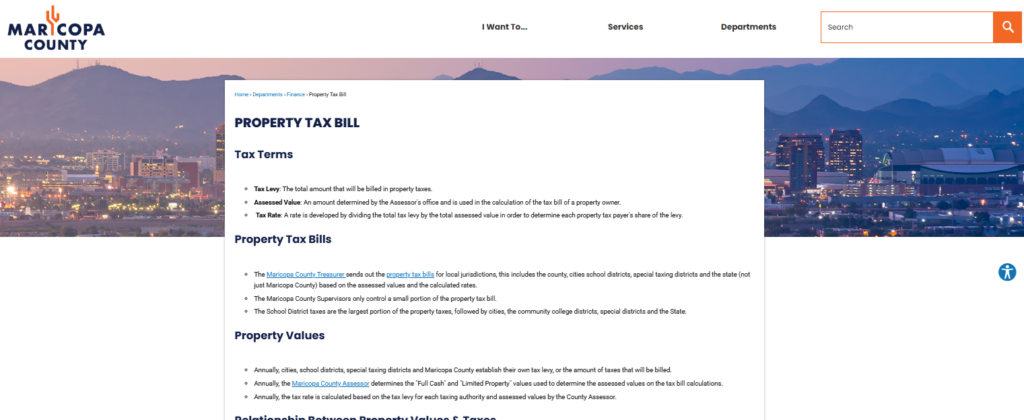
- https://www.maricopa.gov/915/Property-Tax-Bill
- Teacher salaries and staffing
- School building maintenance
- Transportation services like buses
- Classroom materials and programs
Higher home values or school district rates can raise this portion of the bill. This part reflects how the municipal taxation structure supports education services.
County Taxes
County taxes support services managed at the Maricopa County level. These funds go into wide public service operations.
Common allocations include:
- Sheriff and public safety services
- Public health programs
- Court systems and legal services
- Road maintenance across county areas
This portion shows how county-level tax allocation supports essential regional services.
City Taxes
City taxes apply when a property sits inside city limits. These funds support services at the municipal level.
Typical uses include:
- Local police and fire services
- Street cleaning and lighting
- Parks and recreation programs
- Local planning and zoning services
This part of property billing changes based on city boundaries and local tax rates.
Special Districts
Special districts cover specific services that do not fall under city or county control. These charges vary by location.
Examples include:
- Water and irrigation districts
- Flood control districts
- Library districts
- Street lighting zones
These districts reflect targeted government funding breakdown for specific community needs.
Important Property Tax Due Dates & Deadlines
Maricopa County property taxes follow a fixed yearly payment schedule set by county rules. The Maricopa County, AZ, property tax system splits the tax payment into two installments with set due dates and a https://treasurer.maricopa.gov/ strict penalty timeline. The first installment is due in early fall, followed by a second installment in spring. Missing any due date impacts due date compliance and triggers added charges under the penalty timeline.
First Installment Payment Schedule
The first tax payment installment typically starts on October 1 each year. It becomes delinquent after November 1, which marks the first stage in the payment schedule cycle. Property owners can pay the full amount or half during this phase. Early tax payment helps avoid added costs and keeps records aligned with county tax records.
Points for first installment:
- Due date: October 1
- Delinquent after: November 1
- Covers: First half of annual property tax bill
- Late status starts penalty timeline actions
This phase supports smooth Maricopa County, AZ, property tax processing and reduces stress during the year-end financial period.
Second Installment & Delinquency Timeline
The second installment begins on March 1 and follows a similar tax payment structure. It turns delinquent after May 1, which activates the next stage in the penalty timeline. Late tax payment after this date increases charges and may place restrictions on property records.
Delinquency timeline:
- March 1: Second installment due date
- May 1: Delinquent status begins
- Post-deadline: Interest and penalties apply
The payment schedule stays consistent each year, helping property owners plan for due date compliance. Tracking both installments closely reduces the risk of added fees and keeps Maricopa County, AZ, property tax obligations in good standing.
How to Pay Property Taxes in Maricopa County
Property tax payments in Maricopa County follow a structured system set by the Maricopa County, Arizona, offices. Residents complete tax payment through digital tools, mail, in-person counters, or partner banks. The process supports multiple payment methods for Maricopa County, AZ taxes, with clear confirmation steps after submission. Each option connects to the county tax system so payments post to the correct parcel account. Property owners can complete tax payments using the online tax payment portal, e-check payment system, or credit card tax payment channels.
Online Payment System Steps
The online tax payment portal offers the fastest method for Maricopa County, AZ taxes. Users can complete payments anytime through a secure county system.
Steps for online tax payment:
- https://treasurer.maricopa.gov/PropertyTaxInformation/PaymentOptions
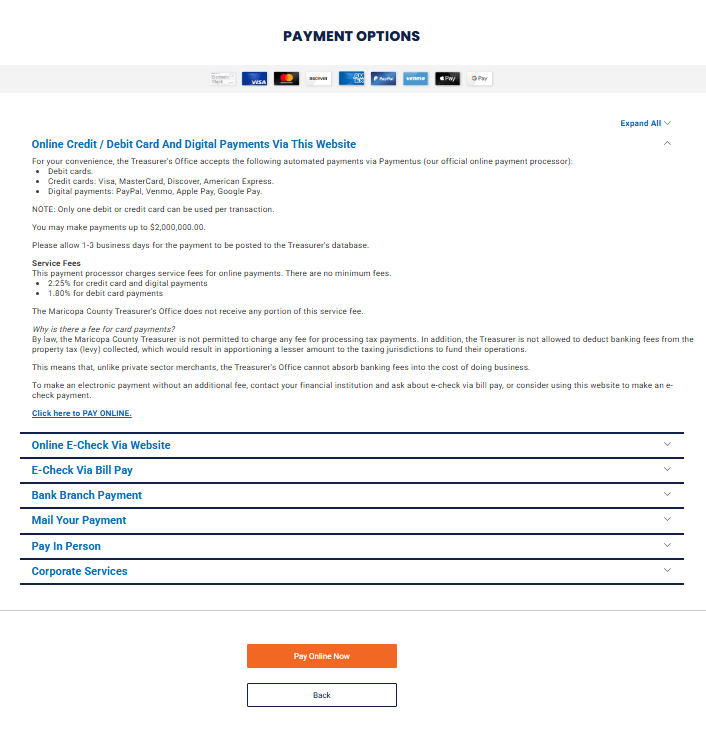
- The official Maricopa County Treasurer payment portal
- Enter parcel number or account details
- Select tax payment type
- Choose payment method:
- e-check payment system
- credit card tax payment option
- Confirm payment details before submission
- Submit and wait for the transaction confirmation screen
After submission, the system generates a digital receipt. Users can download or print a confirmation for records.
Mail Payment Method
Mail-based tax payment remains a common option for property owners who prefer paper transactions. Payments must match parcel details to avoid delays in processing Maricopa County, AZ taxes.
Steps for mail payment:
- Prepare a check or money order payable to the Maricopa County Treasurer
- Write the parcel number on the memo line
- Include the payment coupon from the tax statement
- Place documents in a secure envelope
- Send to the official Treasurer mailing address listed on the tax statement
Processing time depends on postal delivery and the internal posting schedule. Payments are posted only after receipt and verification.
In-Person Payment Option
In-person tax payment allows direct submission at county service locations. Staff assists with account verification and payment posting for Maricopa County, AZ, taxes.
Steps for in-person payment:
- The Maricopa County Treasurer’s office location
- Bring a tax statement or parcel number
- Present a valid ID if required for verification
- Pay using cash, check, or card options
- Receive a printed receipt immediately after payment
Counter staff can also confirm the account balance before payment completion.
Bank Payment Option
Selected banks across Maricopa County accept property tax payments through authorized processing channels. This option links payments directly to county systems.
Steps for bank payment:
- A participating bank branch
- Provide property tax statement or parcel number
- Submit payment using approved methods
- Bank forwards the transaction to the county treasury system
Processing time may vary based on bank submission schedules.
What Happens If You Don’t Pay Property Taxes?
If property taxes are not paid in Maricopa County, penalties start adding up along with interest charges on the unpaid balance. Over time, unpaid amounts can lead to a tax lien sale and possible foreclosure risk on the property. Delinquent accounts move into a legal process that affects ownership rights and tax records linked to the property.
Penalties, Interest Rate, and Tax Records Impact
When a tax payment is missed, the account becomes delinquent and penalties begin immediately under the county’s delinquent tax consequences system. Interest keeps increasing until the full balance is cleared, making the debt grow each month.
Effects on records and balance:
- Late penalty fees added to the original tax amount
- Monthly interest rate applied to the unpaid balance
- Negative updates in official tax records
- Risk of additional collection actions over time
In Maricopa County, interest commonly accrues at a set monthly rate regulated by Arizona tax law. This increases the total cost fast if payment delays continue.
Tax Lien Sale and Foreclosure Risk
If taxes remain unpaid for an extended period, the county may place the property into a tax lien sale. Investors can purchase the lien, paying the overdue taxes on behalf of the owner. The owner then owes repayment with added interest to the lien holder.
Main stages in this process:
- Taxes remain unpaid beyond the deadline
- The county records a tax lien on the property
- The lien may be sold at public auction
- The owner must repay the lien plus interest to remove the claim
If repayment does not happen, the situation may move toward foreclosure. This creates real foreclosure risk, where ownership rights can be lost through legal action after required waiting periods.
Property Tax Exemptions and Relief Programs
Maricopa County property tax exemptions and relief programs reduce tax liability for eligible homeowners. These programs under maricopa county az taxes rules support seniors, disabled residents, and surviving spouses through targeted property billing adjustments. Relief options may lower the assessed value or limit yearly increases through tools like a valuation freeze. Qualification depends on exemption eligibility tied to income, age, or disability status.
Senior Relief Programs
Senior relief programs support older homeowners facing rising property tax costs in Maricopa County. These programs can reduce taxable value or slow increases in yearly bills. Many seniors apply when property billing becomes harder to manage on a fixed income. A common feature includes a valuation freeze, which can lock assessed value at a lower level if requirements are met.
Points for seniors:
- Age-based qualification, often 65 or older
- Income limits set by county rules
- Primary residence requirement
- Reduced assessed property value in some cases
A tax relief program for seniors can lower yearly financial pressure tied to housing costs.
Disability Exemptions
Disability exemptions apply to residents with qualifying physical or medical conditions that affect income stability. These exemptions fall under Maricopa County property tax rules linked to exemption eligibility standards.
Common features include:
- Full or partial reduction in taxable value
- Property billing adjustments based on income level
- Proof of permanent disability status
- Ownership of primary residence
Applicants often submit medical verification and income details. Approved cases may see reduced tax assessments, helping balance living costs under Maricopa County, AZ taxes.
Widow/Widower Relief
Widow and widower relief programs support surviving spouses after the loss of a partner. These programs help maintain housing stability during financial transition.
Eligibility factors include:
- Legal proof of spouse’s passing
- Income qualification limits
- Primary residence status
- Continued ownership of the property
This tax relief program may reduce annual property tax obligations. In some cases, a valuation freeze helps prevent sudden increases in property billing after eligibility approval.
How to Check Your Property Tax Records Online
Property tax records in Maricopa County can be checked through the county’s official property lookup system. The online system shows tax bills, payment history, and current balances for any parcel in the Maricopa County, AZ property tax database. Users can search by parcel number, owner name, or property address to view full tax details. The digital records search also displays tax statement access, payment status, and yearly charges.
Search Property Tax Records Online
The first step is to open the county property lookup system and enter property details. Searches can be done using parcel number or street address linked with Maricopa County, AZ property tax records. Results show a full record set tied to the property, including assessed value and yearly tax amounts.
Common search inputs:
- Parcel number
- Property address
- Owner name
The system pulls results from a digital records search database that updates tax data regularly.
Find Tax Bill and Statements
After selecting a property, the system shows current and past tax bills. The tax bill section lists due dates, charges, and payment history in clear format. Tax statement access shows yearly summaries and installment breakdowns. Users can compare multiple years of tax records to track changes in property tax amounts.
Items shown in records:
- Current tax bill
- Past payment history
- Yearly tax statements
- Outstanding balances
This section helps users confirm payment status and review property tax records without office visits.
Use the County Portal for Record Details
The Maricopa County property portal serves as the main entry point for digital records search. It connects property details, valuation data, and tax statements in one system. The property lookup system also links tax statement access with parcel-level data, helping users review full property tax history.
Features of the portal:
- Parcel-based search tool
- Yearly tax record archive
- Payment tracking system
- Property valuation details
This structure supports quick review of tax records and helps users stay informed about Maricopa County, AZ, property tax updates.
Contact the Maricopa County Tax Departments
Maricopa County Treasurer and Assessor offices handle property billing and tax records for property owners in the county. They respond to questions related to payments, valuations, and account updates. Both departments support the county tax office support requests and government assistance for residents. Office support lines handle high call volume during tax season.
Treasurer and Assessor Contact Details
Maricopa County Treasurer
- Address: 301 W Jefferson St, Phoenix, AZ 85003
- Phone: 602-506-8511
- Handles property billing, payment status, and tax statements
Maricopa County Assessor
- Address: 301 W Jefferson St, Phoenix, AZ 85003
- Phone: 602-506-3406
- Manages property valuation, tax records updates
These offices handle key services linked to property billing, payment history, and ownership records.
(FAQs) About Property Tax
Homeowners often ask why Maricopa County, AZ, taxes change and how the final tax payment is calculated each year. Most changes come from valuation updates, tax rate shifts, and local funding needs. These factors directly impact the annual property tax bill.
Why do property taxes increase?
Property taxes increase mainly due to valuation changes in a home or land. When market prices rise, the assessed value also goes up. This leads to higher tax amounts even if the rate stays the same. Other tax increase factors include home improvements, added square footage, and rising local service costs. School funding and city budgets also affect yearly changes. These combined updates often result in a higher tax payment.
How do assessments work, and what affects the tax rate?
Property assessment in Maricopa County starts with data collection and market comparison. The assessor reviews similar properties and assigns a limited property value (LPV). This value becomes the base for taxation. The tax rate changes based on local budget needs. School districts, city services, and voter-approved bonds all contribute to the final rate. Each district adds its share, which affects the total tax bill.
- School district funding needs
- City and county budget changes
- Special district charges
- Bond or levy approvals
| Factor Type | Impact on Tax Payment |
|---|---|
| Valuation updates | Alter’s percentage applied |
| Rate adjustments | Alters percentage applied |
| Local levies | Changes the taxable base |
Can property taxes be reduced?
Property taxes can be reduced in some cases through review or appeal. Homeowners may challenge incorrect valuations if property details or market value do not match assessment updates. This process can adjust the tax amount if errors are found. Common options include filing a valuation appeal, correcting property records, and checking eligibility for exemptions. These steps may lower the final tax payment if approved by county officials. Regular review of notices helps homeowners stay aware of any changes in their property tax bill.
What happens if property taxes are not paid on time?
Late or missing tax payments can lead to penalties and added interest charges. Over time, unpaid taxes may result in liens placed on the property. Maricopa County sends notices before escalation. Payment delays increase the total amount owed, so timely payment helps avoid extra costs.
How often are property taxes reassessed?
Property taxes are reassessed regularly based on updated market data and county schedules. These assessment updates reflect changes in home value and local market conditions. Reassessments may happen annually or in set cycles. Any shift in property condition, upgrades, or neighborhood prices can influence the new valuation and future tax bill.