
The Maricopa County Justice Court handles local-level legal matters across Arizona precincts under the state court system. It processes civil and traffic cases within a limited jurisdiction structure focused on routine disputes and violations. This court plays a defined role in the Arizona justice system, managing lower-level cases such as traffic citations, small civil claims, and landlord-tenant issues across multiple precincts in Maricopa County.
The Maricopa County Justice Court operates under Arizona’s structured court system with limited jurisdiction authority. It hears specific case types set by state law, including traffic violations, civil disputes with lower monetary value, and local ordinance matters. Each precinct court follows geographic boundaries, which helps distribute workload evenly across the county’s legal structure. This setup improves case handling speed and keeps higher courts focused on serious criminal and complex civil cases. Residents use this court for everyday legal issues that require local resolution within defined precinct jurisdictions.
What is the Maricopa County Justice Court?
Maricopa County Justice Court is a local court that handles lower-level legal matters within specific geographic precincts. It manages selected civil cases, misdemeanor cases, and small claims disputes under defined legal limits. This court operates under limited authority and focuses on faster, simpler case processing compared to higher courts in Arizona.
Limited Jurisdiction
Maricopa County Justice Court works under justice court jurisdiction, which means it only hears certain types of cases defined by Arizona law. It does not handle high-value or serious felony matters.
This court commonly processes cases such as:
- Civil disputes with limited financial claims
- Misdemeanor cases, such as minor offenses
- Landlord and tenant disputes
- Small claims matters
- Traffic violations
Cases outside its authority include:
- Felony criminal cases
- Large civil lawsuits exceeding monetary limits
- Family law matters like divorce or custody
- Appeals from higher courts
The Superior Court of Arizona in Maricopa County handles those complex and high-level matters. Justice Court serves as a lower-tier court focused on quicker resolutions and simplified procedures.
Justice Court vs Superior Court
| Feature | Justice Court | Superior Court |
|---|---|---|
| Case Type | Civil cases, misdemeanor cases | Felonies, family law, major civil cases |
| Monetary Limits | Lower claim amounts | No strict lower limit |
| Procedure | Simplified process | Formal court process |
| Jury Trials | Limited | Common in serious cases |
Justice Court often acts as the first stop for many local legal issues before escalation to higher courts.
Role of Justice of the Peace & Constable
The Justice of the Peace serves as the judge in the Maricopa County Justice Court. This role includes reviewing evidence, hearing arguments, and issuing rulings within court authority.
Responsibilities include:
- Presiding over civil cases and misdemeanor cases
- Setting court procedures within precinct rules
- Issuing judgments and court orders
- Handling small claims disputes
The Constable works as the enforcement officer for the court. This role focuses on carrying out court orders and maintaining the lawful execution of judgments.
Maricopa County Justice Court Case Search & Calendars
The Maricopa County Justice Court case search allows users to locate public case details for traffic, civil, and misdemeanor matters. Court calendars display upcoming hearings, assigned courtrooms, and current case activity. This system supports quick case lookup using online records. It helps users track court docket entries and hearing schedules across different justice court locations in Maricopa County.
How to Search a Case Online
Online search tools for the Maricopa County Justice Court provide two main methods for locating records. Users can perform a justice court case search using either a person’s name or a specific case number. Both methods help retrieve https://justicecourts.maricopa.gov/ court records, filing status, and hearing details. A name-based search works best when the case number is not available. The system may show multiple matching records tied to similar names. Filters such as filing date or court location help narrow results. A case number search delivers faster and more precise results. Each case number is unique and links directly to the court record, docket entries, and scheduled events.
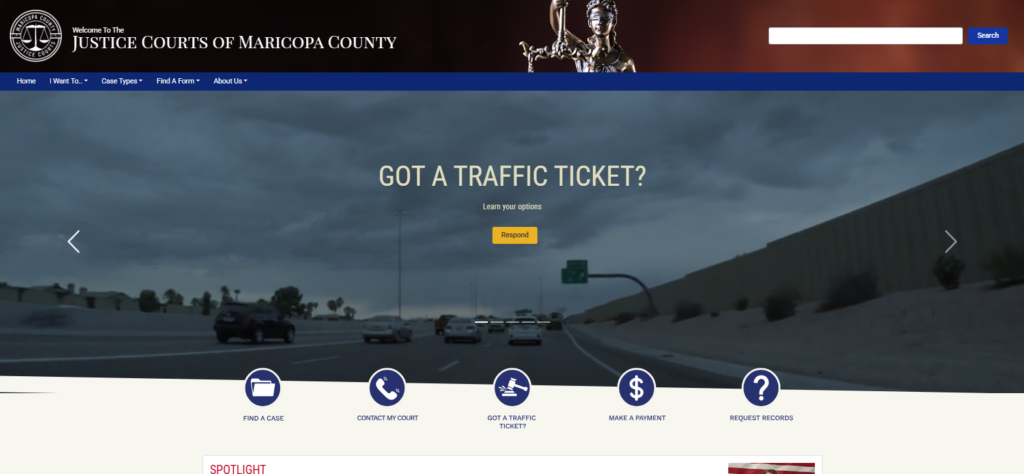
Search options include:
- Name search: Finds cases linked to a party’s full or partial name
- Case number search: Pulls exact records tied to a unique identifier
- Case lookup tools: Show filing history, case type, and status updates
- Court docket search: Displays hearings, motions, and court actions
These tools help users track court records, review filing updates, and confirm hearing dates without visiting a courthouse.
The Court Dockets
A court docket lists all scheduled and recorded activities for a case within the Maricopa County Justice Court system. It serves as a timeline showing how a case moves through different stages. Dockets include filings, motions, rulings, and hearing events. Each entry reflects a specific action taken by the court or involved parties. This record helps track both past and upcoming case activity.
Court calendars and docket listings often show:
| Docket Element | Description |
|---|---|
| Hearing date | Scheduled court appearance |
| Case status | Active, closed, or pending review |
| Event type | Trial, arraignment, motion hearing |
| Courtroom info | Assigned location and division |
Hearing listings appear directly on court calendars and are updated as schedules change. Users can review these listings to confirm dates, times, and assigned judges.
Case Types Handled by Justice Court
Maricopa County Justice Court handles several common legal disputes that involve traffic violations, money-related claims, housing conflicts, and personal safety protection cases. It also processes civil cases and small claims court Maricopa County, AZ matters within its jurisdiction, focusing on resolving everyday legal issues between individuals, tenants, landlords, and local agencies. This court also deals with traffic court matters such as speeding tickets, DUI misdemeanors, and other civil traffic violations, along with landlord-tenant law disputes and protective order requests that relate to safety and harassment concerns.
Traffic & Civil Traffic Violations
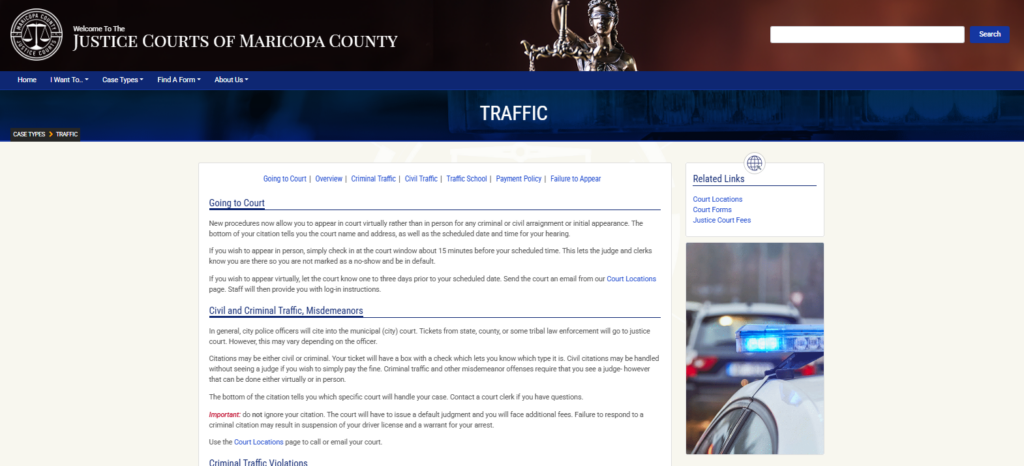
Maricopa County Justice Court processes a large volume of traffic court matters. These cases involve drivers cited for breaking road laws within county limits.
Common case types include:
- https://justicecourts.maricopa.gov/case-types/traffic
- Speeding tickets and moving violations
- Red light or stop sign citations
- Unsafe lane changes or reckless driving allegations
- DUI misdemeanors are handled at the justice court level
- Failure to appear for a traffic citation
Civil traffic violations usually focus on fines and driving records. DUI misdemeanor cases may involve court appearances, penalties, or driving restrictions depending on case facts.
Small Claims Court Cases
Small claims court maricopa county az deals with civil disputes involving limited monetary amounts between individuals, tenants, landlords, and small businesses. These cases commonly include unpaid loans, consumer complaints, security deposit disagreements, service payment issues, and property damage claims under the legal dollar limit. The process is simplified so people can present their case without formal legal representation. Judges review evidence such as receipts, contracts, messages, and invoices to decide outcomes. This court structure supports faster resolution of financial disputes, especially when legal claims involve everyday transactions and straightforward monetary disagreements.
Evictions & Landlord-Tenant Cases
Eviction cases form a major part of justice court work and relate directly to landlord-tenant law across Maricopa County. These disputes often involve nonpayment of rent, lease violations, holdover tenants, early lease termination issues, or property damage concerns. The process usually begins with a written notice from the landlord, followed by a filing in justice court if the issue is not resolved. After filing, a hearing is scheduled where both sides present their case, and a judge issues a decision that may include eviction orders. These cases move on strict timelines and often involve urgent housing-related concerns between landlords and tenants.
Protective Orders & Legal Protection Cases
Maricopa County Justice Court also handles protective orders for personal safety. These cases focus on legal protection from harassment, threats, or abuse.
Common protective order types include:
- Orders of protection for domestic relationships
- Injunctions against harassment
- Workplace or neighbor-related protection cases
- Emergency protective filings in urgent situations
These cases involve immediate court review in many situations. Judges may issue temporary orders before a full hearing.
How to Find Your Justice Court Precinct
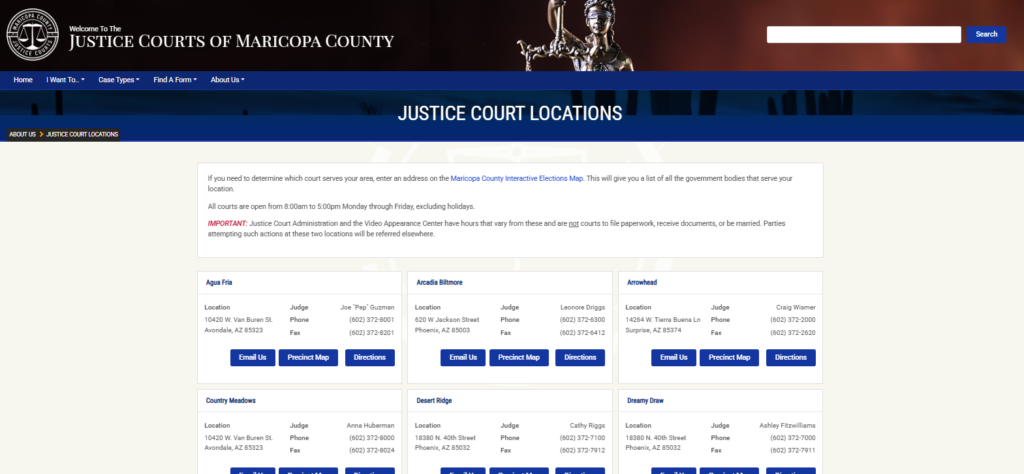
A Maricopa County Justice Court precinct is determined by the exact residential or incident address linked to a case. Each address falls under a specific precinct that controls where filings are submitted and which court handles the matter. This system connects every location in the county to set court precincts based on jurisdiction rules and geographic boundaries. It helps match each case with the correct court within the available Maricopa County Justice Court locations.
Why Precinct Matters
Court precincts decide which court has authority over a case and where legal documents get filed. This structure supports clear jurisdiction rules so cases are assigned to the correct judge and courtroom. It also keeps location-based case handling organized across Maricopa County. Each precinct operates within fixed geographic lines that control filing locations, case processing, and hearing assignments. Civil traffic cases, misdemeanor matters, and small claims follow these boundaries for proper court placement.
Reasons precincts matter:
- https://justicecourts.maricopa.gov/about-us/court-locations
- Case assignment control: Each precinct assigns judges to cases within its zone
- Jurisdiction clarity: Prevents filing in the wrong court location
- Location-based filing: Documents must match the correct precinct office
- Local processing system: Keeps court workload balanced across regions
- Court identification: Links every address to a specific justice court branch
These rules help residents and legal professionals match filings with the correct precinct without delays or rejections.
How the Address Determines the Court
Every address in Maricopa County connects to a specific justice court precinct through mapped boundaries. These boundaries are based on streets, ZIP codes, and municipal zones.
The process follows a clear structure:
- Start with the full street address, including city and ZIP code
- Match the address against official precinct maps used by the court system
- Identify the assigned jurisdiction area tied to that location
- Confirm the related Maricopa County Justice Court locations serving that precinct
- Submit filings or attend hearings at the assigned court branch
The address-based system helps route cases correctly across civil, traffic, and misdemeanor matters. It reduces confusion and keeps each filing connected to the proper court office.
How to File a Case in Justice Court
A person can file a case in the Maricopa County Justice Court by completing required forms, submitting them at the correct precinct, and paying the filing fee. The civil filing process follows a set filing procedure that supports proper court submission of legal documentation. The process focuses on accurate court forms, correct jurisdiction, and timely filing at the assigned Justice Court precinct. Each step plays a direct role in how the case moves forward in the system.
Confirm Eligibility
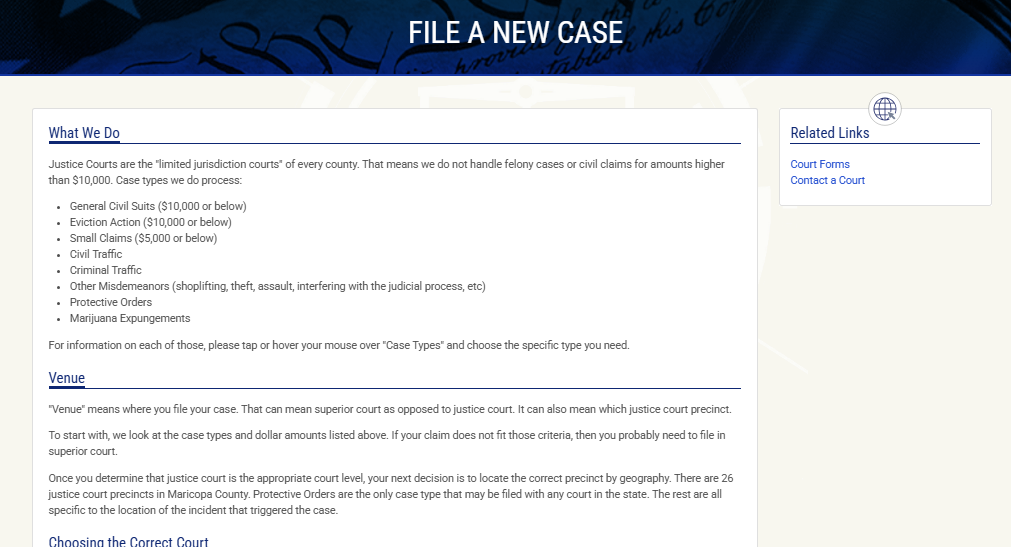
The first step in filing a case in the justice court process involves checking whether the matter belongs in Justice Court. These courts usually handle civil claims with limited monetary value and specific case types.
Common case categories include:
- https://justicecourts.maricopa.gov/i-want-to/file-a-new-case
- Debt disputes under state limits
- Landlord-tenant conflicts
- Property damage claims
- Contract disagreements
- Small civil recovery matters
A case must fall within the court’s jurisdiction rules. If the claim exceeds the monetary limit or involves complex legal claims, another court may handle it.
Prepare Forms
The next stage of the civil filing process involves preparing court forms. These documents provide details about the claim, parties involved, and the requested outcome.
Typical court forms include:
- Civil complaint form
- Summons form
- Additional case information sheet
- Proof of address or service details
Each form must contain accurate and complete information. Errors or missing fields may delay court submission.
File at the Correct Precinct
After preparing documents, the case must be filed at the correct Justice Court precinct. Maricopa County has multiple precincts, each serving specific geographic areas. Filing at the wrong precinct can delay processing or result in rejection.
Steps in this filing procedure:
- Identify the precinct tied to the defendant’s residence or the incident location
- Submit completed court forms to the clerk’s office
- Receive the case number after submission
Court submission may occur in person or through approved filing systems, depending on precinct rules. Staff review documents for completeness before accepting the case.
Precinct selection affects:
- Case processing time
- Court scheduling
- Notification delivery
Proper jurisdiction matching supports smoother case movement through the system.
Pay Filing Fees
The final step in how to file a case in a justice court involves paying filing fees. Fees vary based on case type and claim amount.
Typical fee structure:
| Case Type | Estimated Fee Range |
|---|---|
| Small civil claims | Lower fee tier |
| Contract disputes | Moderate fee tier |
| Higher-value claims | Higher fee tier |
Accepted payment methods often include cash, money order, or card, depending on precinct policy.
Maricopa County Justice Court: Tickets, Citations & Payments
A traffic citation in Maricopa County requires a response within the stated deadline printed on the ticket. The case is handled through the local traffic court Maricopa County system, where options exist for payment, court appearance, or defensive driving eligibility. Most cases involve court fines, citation handling fees, or scheduled hearings based on the violation type. A citation payment can be completed online, by mail, or in person, depending on eligibility.
What to Do After Receiving a Ticket
A traffic ticket from the Maricopa County Justice Court starts a legal timeline that must be addressed before the due date. The ticket shows violation details, court location, and response options. Missing the deadline may lead to extra penalties or a hold on driving privileges.
A typical response path includes:
- Reading the citation for the violation code and the due date
- Checking eligibility for payment or court appearance
- Confirming case details through the court system
- Choosing one response option before the deadline
The driver may select payment of court fines, request a hearing, or contest the citation. Each option affects the final case outcome. The court records the response and assigns the case status. In many traffic court Maricopa County cases, early action prevents added fees or enforcement actions.
Payment Options
The Maricopa County Justice Court provides several methods for citation payment. Each method supports different user needs based on convenience and case type.
Common payment methods include:
- https://justicecourts.maricopa.gov/about-us/justice-court-fees
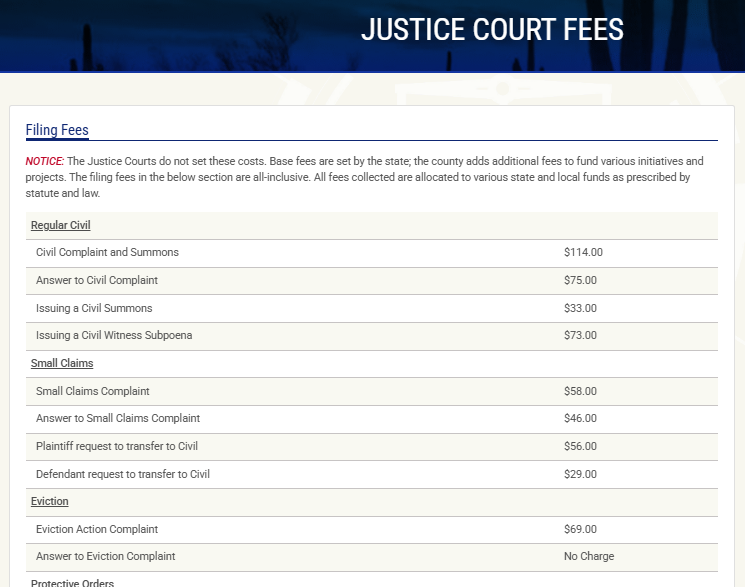
- Online payment portal using citation or case number
- Mail-in payment with check or money order
- In-person payment at court locations
- Phone payment in selected cases
Payments often cover court fines, administrative fees, and penalty assessments. Full payment closes the case in most minor traffic violations. Partial payments may be available under approved arrangements in specific situations.
Defensive Driving School Option
Certain traffic violations in Maricopa County qualify for a defensive driving program. This option may replace court fines with course completion, depending on eligibility rules set by the court.
Eligibility usually depends on factors such as:
- No prior defensive driving use within the allowed timeframe
- Non-commercial license status
- Eligible violation type listed on the citation
Steps involved in this option include selecting an approved school, completing the course, and submitting proof to the court. Once accepted, the citation is dismissed from the driving record in qualifying cases.
Attend Your Justice Court Hearing
A justice court hearing is a formal court appearance where a judge reviews a case, hears both sides, and decides the next steps. The process may take place in person or through a virtual court setup, depending on the case type and court schedule. A person involved in a case must appear at the scheduled time listed on the court notice or docket. Missing the court hearing can lead to penalties or a default decision in justice court proceedings.
In-Person vs Virtual Hearings
Justice courts offer two formats for court hearing attendance: in-person sessions at the courthouse and virtual court sessions held online.
In-person hearings
- https://justicecourts.maricopa.gov/i-want-to/attend-a-hearing
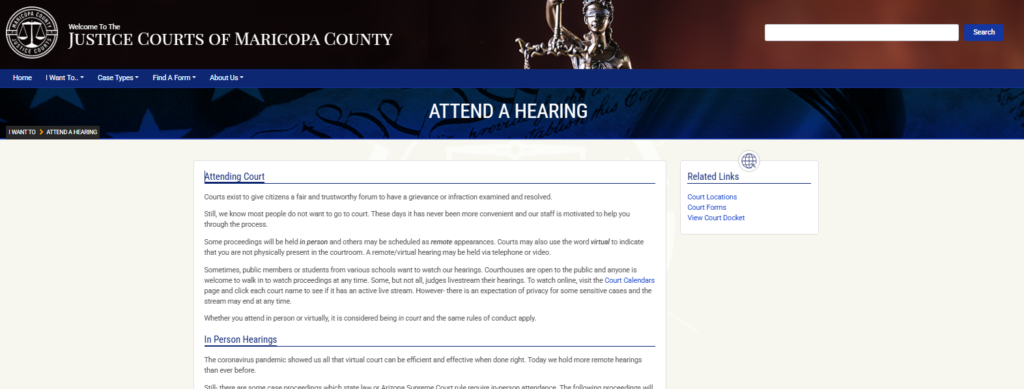
- Held inside the assigned justice court building
- Parties appear before the judge in a courtroom
- Court staff, clerk, and attorneys may be present
- Physical documents may be reviewed during the session
Virtual court hearings
- Conducted through secure video platforms
- Participants join from a phone, tablet, or computer
- Case participants join using a meeting link or ID
- Remote participation follows the same court rules as in-person hearings
Both formats follow the same justice court proceedings rules. The judge reviews statements, case files, and any submitted evidence in both setups.
How to Prepare for Court
Preparation for a court hearing helps keep the process organized and on track. The justice court expects each party to be ready with case-related details and supporting documents.
Preparation steps include:
- Bring a copy of the hearing notice or court summons
- Review the case filing and all related paperwork
- Organize evidence such as receipts, photos, or written records
- Prepare a short statement of facts related to the case
- Arrive early for in-person sessions or log in early for virtual court
Proper preparation also includes checking the assigned courtroom or meeting link. Court staff may reject late arrivals or late logins, which can affect the hearing outcome.
What Happens During a Hearing
A justice court hearing follows a structured process led by a judge. Each party receives time to present its side of the case.
Typical steps in justice court proceedings include:
- Case call: The judge calls the case name and case number
- Opening statements: Each side briefly shares its position
- Presentation of facts: Documents, statements, and records are reviewed
- Questions from the judge: The judge may ask for clarification
- Closing remarks: Final short statements from both sides
- Ruling or next steps: The judge may issue a decision or set another date
During a virtual court session, participants must keep microphones muted when not speaking and follow instructions from the court staff. Disruptions or late entry can delay the process.
Court Records, Retention & Requests
Maricopa County Justice Court maintains court records that include case filings, judgments, and supporting case documents. These records may be obtained through a legal records request process, based on record type and availability rules set by the court system. Court records play a key role in public transparency and case tracking. They include both active and closed case files, along with docket information and official court actions.
What Records Are Available
The court maintains several types of court records tied to civil, criminal, traffic, and small claims matters. These records often support legal review, case verification, and public record searches.
Common record types include:
- https://justicecourts.maricopa.gov/i-want-to/request-records
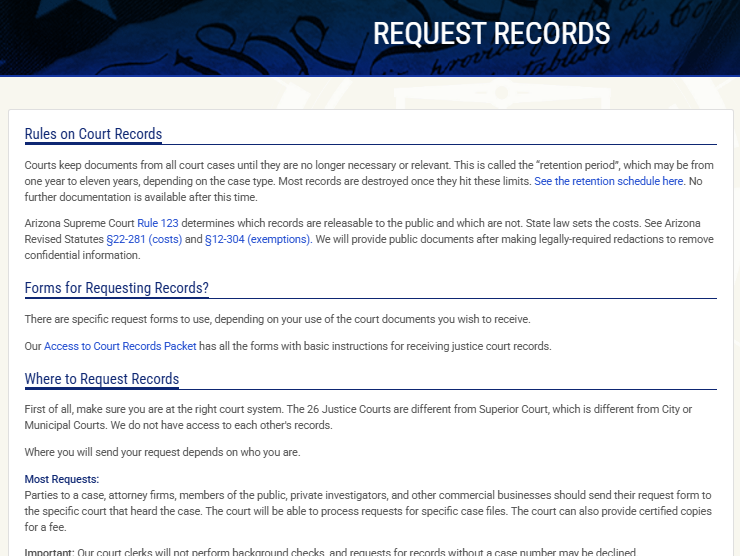
- Case filings (complaints, petitions, responses)
- Judgments and orders issued by the judge
- Docket information showing case activity timeline
- Hearing schedules and notices
- Case documents submitted by parties
- Payment and fine records
These legal records may be public or restricted based on privacy laws, case type, or sealing orders. Some sensitive documents may require authorization before release.
How to Request Documents
A legal records request may be submitted to obtain copies of court files or specific case documents. Requests typically require case details to locate the correct file.
Common steps include:
- Provide case number or party names
- Specify the requested case documents
- Submit the request through the court clerk’s office channels
- Pay copy or certification fees, if required
- Wait for processing and document preparation
Requests can involve civil case files, traffic records, or criminal case summaries. Response time depends on workload and record type.
Record Retention Rules
Court records follow a record retention schedule that defines how long documents are kept before storage or destruction. Retention periods vary based on case category and legal requirements.
| Record Type | Retention Period |
|---|---|
| Civil case files | Several years after closure |
| Traffic cases | Short to medium-term storage |
| Criminal records | Extended retention periods |
| Financial records | Fixed retention cycle |
Older case documents may be transferred to archives or removed after the retention period ends. Some records remain permanently preserved, especially those with long-term legal value.
Appeals & Post-Judgment Process
Appeals and post-judgment actions in Maricopa County Justice Court allow parties to challenge a ruling or request changes after a case ends. The court appeal process gives a structured way to request a review of a judgment. Post-judgment actions include legal remedies such as setting aside judgments and record sealing options.
How Appeals Work
The court appeal process in Justice Court cases allows a higher court to review a final decision. Appeals do not reopen the full case. The review focuses on legal or procedural errors. Appeals often follow strict timelines, usually short after judgment entry. Missing deadlines may block the appeal request.
Common appeal steps
- Filing a Notice of Appeal with the Justice Court
- Paying the required filing fees or requesting a fee waiver
- Preparing the case record for review
- Higher court reviews written arguments
What appeals review
- Application of the law by the judge
- Procedural fairness during the hearing
- Evidence handling issues
- Legal interpretation mistakes
| Appeal Element | Description |
|---|---|
| Filing step | Notice submitted after judgment |
| Review type | Legal error review, not new trial |
| Decision outcome | Affirm, reverse, or modify ruling |
| Time limit | Short statutory deadline after judgment |
The appeal outcome may confirm the original ruling, change parts of it, or send the case back for further proceedings.
Setting Aside Judgments
A judgment review through a motion to set aside allows a party to request cancellation of a court judgment. This step applies when valid reasons exist that affected fairness or accuracy.
Common reasons for setting aside a judgment
- Lack of proper notice before the hearing
- Clerical or filing mistakes
- Newly found evidence that changes the case facts
- Mistake, surprise, or excusable neglect
Process steps
- Filing a motion with a supporting explanation
- Submitting proof or documents
- Court hearing on the request
- The judge’s decision to approve or deny
If approved, the case may reopen for further hearing or a new decision. If denied, the original judgment remains active.
Record Sealing Options
Record sealing is a legal remedy that limits public view of certain case records. In Justice Court matters, sealing may apply to eligible civil or criminal cases after specific conditions are met.
Situations where sealing may apply
- Dismissed cases
- Cases resolved without conviction
- Older records meet eligibility rules
- Completed post-judgment requirements
Steps involved in record sealing
- Filing a petition for record sealing
- Providing case details and eligibility proof
- Court review of public interest and eligibility
- Final order issued by the judge
Effects of sealed records
- Case no longer appears in public searches
- Limited disclosure to authorized agencies
- Restrictions on public reporting of case details
Sealing does not erase the record. It restricts general public visibility while keeping it for official use.
Justice Court FAQs
Maricopa County Justice Court FAQs provide clear answers to common questions about filing cases, paying tickets, case search, and online court attendance. These answers help users handle basic court tasks with fewer delays and confusion. The Justice Court system covers traffic, small claims, and misdemeanor matters across different precincts in Maricopa County.
Which court do I file in for Maricopa County cases?
Filing depends on the type of case and where it happened in Maricopa County. Each Justice Court precinct handles cases linked to its geographic area. Users usually file in the precinct where the incident occurred or where the defendant lives. Common filings include small claims, traffic violations, landlord-tenant disputes, and certain misdemeanor cases. Case type decides where the paperwork must go. Each precinct court manages its own assigned cases within Arizona court rules.
Can Maricopa County Justice Court tickets be paid online?
Yes, many traffic tickets and civil fines can be paid online through the official payment system. Users enter a citation number or case details to proceed with payment. Payment options often include debit cards, credit cards, and approved online portals. Some cases may also allow payment plans depending on eligibility. Civil traffic violations are the most common type handled online.
How to find a Justice Court case in Maricopa County?
Case information can be found using the Justice Court case search system. Users can search by name, case number, or citation number. Search results show hearing dates, case updates, and current status. This helps users track court progress without visiting the courthouse. The system is commonly used for checking Maricopa County Justice Court case status quickly.
Can Justice Court hearings in Maricopa County be attended online?
Some hearings may be held online using approved video platforms. Availability depends on the judge’s approval and case type. Online hearings are often used for initial appearances and select civil or traffic matters. Court notices provide instructions for joining the virtual session. Users must follow the details listed on their hearing notification.
How do I contact the Maricopa County Justice Court for help?
Maricopa County Justice Court provides contact options for users who need case help or court information. Each precinct court has its own phone number and office hours for public assistance. Users can call the specific Justice Court location handling their case for faster support. General inquiries can include case status, hearing dates, and filing procedures. Many precincts also offer in-person service counters for document help and payment support. Court staff can direct users to the correct department based on case type and location.