
The Maricopa County Tax Assessor assigns property values that local governments use to calculate property taxes across Maricopa County, Arizona. The office studies property records, recent real estate sales, land characteristics, and building details to complete the official property valuation process used for tax assessment. These valuations determine the assessed value placed on residential homes, commercial buildings, and vacant land parcels throughout the county. Many residents search for a property appraiser in Maricopa County AZ, when they want to review how their home’s taxable value was calculated. The assessor maintains detailed parcel records that show ownership history, land classification, and valuation changes. Accurate valuation supports fair property taxation across cities such as Phoenix, Mesa, Chandler, Scottsdale, and Glendale.
Homeowners often interact with the assessor while reviewing their home value determination, checking Maricopa County property records, or verifying parcel details linked to their property tax bill. Each year, the assessor releases a Notice of Value, which lists the assessed value and the limited property value assigned to a property. Property owners frequently compare these numbers with nearby home sales or neighborhood market activity. Real estate professionals, lenders, and property investors review assessor data during property research and valuation analysis. Residents may request a value review if they believe the assessment does not match current market prices. The assessor’s database stores property characteristics such as square footage, construction type, lot size, and improvement details. Public access to these records supports transparency across the county property tax system.
What is the Maricopa County Tax Assessor?
The Maricopa County Tax Assessor is the county office responsible for determining the taxable value of real estate and personal property. The office maintains property records and assigns values used by the local property tax system. In Maricopa County, Arizona, the assessor plays a central role in the county assessment system. The office studies property characteristics, market trends, and land data to calculate https://www.mcassessor.maricopa.gov/home/your_assessor/ fair values for homes, land, and commercial buildings. These values help determine how much property tax each parcel contributes to local services such as schools, roads, and public safety.

The Maricopa County, AZ, tax assessor works with property data across thousands of parcels. Staff members review building size, lot details, improvements, and sales history. They record this information in county property databases that support the broader property valuation process used by local government.
Role of the Assessment Office in Property Valuation
The assessment office acts as the starting point for the property tax cycle. It studies real estate data and assigns a value known as the assessed value. Local taxing authorities apply tax rates to that value to calculate the final property tax bill.
Duties of the property appraiser in Maricopa County, AZ, office include:
- Maintaining official property records
- Reviewing market sales data
- Determining full cash value and limited property value
- Updating property characteristics after construction or renovation
- Handling valuation appeals from property owners
The office relies on a structured county assessment system. This system groups similar properties and analyzes recent market activity. Assessors then estimate values that reflect typical sales prices across neighborhoods.
Difference Between the Assessor and the Treasurer
Property owners often confuse the Maricopa County tax assessor with the county treasurer. Both offices work within the property tax system, though their duties differ.
| County Office | Primary Role | Interaction With Property Owners |
|---|---|---|
| Tax Assessor | Determines property value for taxation | Sends valuation notices and handles assessment appeals |
| County Treasurer | Collects property tax payments | Issues tax bills and manages payment records |
The assessor sets the value, while the treasurer collects the tax. This separation keeps the property valuation process organized and transparent.
What the Assessor Actually Does
The Maricopa County Tax Assessor identifies every taxable property in the county and assigns a fair value for tax purposes. The office maintains parcel records, applies property classifications, and processes exemption requests that affect property taxation. Property taxation depends on accurate records and fair valuation. The assessor’s office performs several core assessment office duties that support local tax systems, city services, and school funding. These responsibilities involve collecting parcel data, running mass appraisal models, and maintaining a consistent property classification system.
Property Identification
Every parcel in Maricopa County must first be identified and recorded before any tax value is assigned. The assessor’s office creates a unique parcel number for each property. This identifier links the property to ownership records, location data, and land characteristics.
Staff collect and update details such as:
- Property address
- Legal land description
- Parcel size and boundaries
- Building structures and improvements
- Construction year and square footage
These records form the county’s parcel database, which acts as the foundation for property taxation.
Valuation Process
After a property is identified, the assessor estimates its taxable value through mass appraisal. This method evaluates many properties at once using market sales, property features, and location data.
The Maricopa County property valuation process typically follows these steps:
- Collect market data: Sales records from homes, land, and commercial buildings.
- Analyze property characteristics: Size, construction type, age, and improvements.
- Apply mass appraisal models: Statistical models compare similar properties.
- Calculate full cash value: An estimate close to the current market value.
- Apply assessment ratios: State rules convert value into taxable assessment.
The assessor reviews sales trends across neighborhoods. If similar homes sell for higher prices, valuation models may increase assessed values for comparable parcels.
Property Classification System
Every parcel receives a classification based on how the property is used. This property classification affects the assessment ratio applied to the property’s value.
Common classification categories include:
| Classification Type | Example Property | Purpose |
|---|---|---|
| Residential | Single-family homes, condos | Primary housing |
| Agricultural | Farms, ranch land | Food production or livestock |
| Commercial | Retail stores, offices | Business activity |
| Rental | Apartment buildings | Income-producing housing |
| Vacant Land | Undeveloped parcels | Future development |
Each category has a different assessment percentage under Arizona tax law. Residential property usually receives a lower assessment ratio than commercial property.
Maintaining Parcel Records
The assessor’s office manages one of the county’s largest property databases. These parcel records track ownership history, land attributes, improvements, and valuation data.
Record maintenance involves several routine tasks:
- Updating ownership after property sales
- Recording new building permits and improvements
- Revising parcel maps and boundaries
- Correcting errors reported by property owners
County staff coordinates with local planning departments and the county recorder to keep information accurate.
Exemptions Handling
Certain property owners qualify for tax reductions through state-approved exemptions. The assessor’s office reviews applications and verifies eligibility.
Common exemptions in Maricopa County include:
- Senior property valuation protection programs
- Disabled person exemptions
- Widow or widower tax relief
- Nonprofit organization exemptions
- Religious or charitable property use exemptions
Applicants submit documentation showing age, disability status, nonprofit use, or other qualifying criteria.
What the Assessor Does Not Do
The Maricopa County Tax Assessor does not collect property tax payments, set tax rates, or control legal ownership decisions. Its role stays limited to property valuation used within the tax system. The office contributes property values that feed into billing records, yet it does not manage payments or tax distribution. This separation often leads to property tax confusion among homeowners who expect one office to handle all tax-related actions.
Property tax confusion and assessor vs treasurer
Property tax confusion often appears when taxpayers mix up assessor vs treasurer roles. The assessor determines property value for taxation, while the treasurer holds tax billing authority and manages collections. This structure reflects clear property tax separation across county departments.
Different agencies handle different functions:
- Maricopa County Assessor: Sets assessed value based on property data
- Maricopa County Treasurer: Sends bills and collects payments
- Maricopa County Recorder: Maintains recorded deeds and property documents
This separation reduces overlap in duties. It also helps maintain accuracy in tax records and billing flow across departments.
What the Assessor does not control in property taxes
The assessor’s office does not set tax rates or decide final tax bills. Those functions come from other counties and local taxing authorities. Rate decisions come from budgets approved by taxing districts, not the assessor. The office also does not establish legal ownership. Ownership records come from recorded deeds filed with the county recorder, not from valuation records.
Limits of the assessor role:
| Function Area | Responsible Office |
|---|---|
| Property value assessment | Assessor |
| Tax billing and collection | Treasurer |
| Tax rate setting | Local taxing districts |
| Ownership recording | County Recorder |
This structure supports clear separation in the property tax system and reduces overlap between agencies handling tax billing authority and valuation work.
How Property Valuation Works in Maricopa County
Property valuation in Maricopa County is based on structured appraisal models that estimate a home’s worth using real market data and property characteristics. The Maricopa County tax assessor’s valuation process sets values that affect annual property taxes. These values come from formulas, sales records, and market activity patterns.
Full Cash Value (FCV) and Limited Property Value (LPV)
Property value in Maricopa County is built on two main figures: Full Cash Value (FCV) and Limited Property Value (LPV). Each plays a different role in tax calculations and home value reporting.
- Full Cash Value
- Full Cash Value (FCV) reflects an estimated market value. It is based on what the property could sell for under normal conditions. The assessor uses sales comparisons, location data, and physical property details to set FCV.
- Limited Property Value
- Limited Property Value (LPV) is used for taxation growth control. LPV usually rises more slowly than market prices. It helps stabilize yearly tax increases even when the housing market moves quickly.
Differences
| Factor | FCV (Full Cash Value) | LPV (Limited Property Value) |
|---|---|---|
| Purpose | Market-based estimate | Tax calculation base |
| Growth | Follows market trends | Controlled growth rate |
| Use | Value reporting | Property tax billing |
FCV connects closely with market value, while LPV controls how taxes increase over time.
Market Value vs Assessed Value in Property Valuation
Market value shows what a buyer may pay for a home in current conditions. Assessed value is the figure used for taxation after applying rules set by Arizona law. The property valuation process in Maricopa County often creates differences between these two numbers.
Market value depends on:
- Recent home sales nearby
- Buyer demand in the area
- Property upgrades or condition
- Location factors like schools and transit
Assessed value depends on:
- FCV calculations
- LPV limits
- State assessment ratios
In many cases, a home value in the open market is higher than the assessed value used for taxes. This gap exists because tax formulas limit sharp increases.
Mass Appraisal System and Data Sources
Maricopa County uses a mass appraisal model to evaluate thousands of properties at the same time. This system relies on data-driven rules rather than individual inspections for every home each year.
The appraisal model collects and processes large sets of data, including:
- Recent property sales across neighborhoods
- Local property trends and price movement
- Home size, age, and construction type
- Lot size and land use classification
- Location advantages or disadvantages
- Renovation and building permit records
This system applies market analysis techniques to estimate FCV across entire neighborhoods. Computer models compare similar homes to maintain consistency.
Why Neighbors May Have Different Property Values
Even homes on the same street may show different valuation numbers. The Maricopa County, AZ, tax assessor’s valuation system assigns values based on detailed property-specific data.
Common reasons for differences include:
- Home size variation: Larger square footage increases value
- Renovations: Updated kitchens or added rooms raise FCV
- Lot differences: Corner lots or larger yards affect pricing
- Age of structure: Newer homes often carry higher values
- Sale history: Recent sales near a property influence pricing models
- Condition rating: Maintenance level changes appraisal results
Your Valuation Notice
A valuation notice from Maricopa County is an official document that shows how a property’s value was assessed for tax purposes, and it explains key property assessment details that impact future tax bills. This tax notification is sent to property owners each year so they can see updated values, changes from the previous year, and the final valuation breakdown used for tax calculations. It helps property owners clearly understand how the county arrived at the assessed value.
What the Valuation Notice Contains and Why It Is Sent
The Maricopa County Assessor issues an assessment letter each year to inform owners about updated property values, and it is not a tax bill but a value statement used for later tax billing. It usually includes parcel number, property address, ownership details, and classification, along with full cash value and limited property value figures. It also shows changes from the previous year and may include notes explaining why the value increased or decreased, such as market shifts or property improvements.
How to Read Property Assessment Details
The valuation notice for Maricopa County is divided into clear sections that show property assessment details step by step, making it easier to review. The top section contains basic property information like parcel ID and legal description, while the middle section shows value figures such as full cash value and limited value side by side. The change section highlights differences from the prior year, and a simple table is often used to compare property info, value details, change summary, and classification, helping the reader understand the full valuation breakdown quickly.
Deadlines and Response Timeline
Each tax notification includes a specific review period that usually starts when the notice is issued in early spring and lasts around 60 days, with the exact deadline printed on the document. During this time, property owners can review all details, compare values with similar properties, and check for accuracy in the assessment. If any issue is found, a review request or appeal can be submitted before the deadline, and missing this date may limit the ability to make changes or corrections.
How to Appeal Your Property Value
A property valuation appeal lets a homeowner challenge the assessed value set by the Maricopa County Assessor. This process can lower the taxable value when the assessment appears higher than fair market conditions. An effective property valuation appeal in Maricopa County relies on strong records, clear evidence, and timely filing through the official Maricopa County assessor appeal system.
When to Appeal Property Value
A property value appeal becomes relevant when the assessed value does not match real market conditions. Many homeowners file an appeal after noticing sudden tax increases or valuation shifts.
Common situations that trigger a review:
- https://www.mcassessor.maricopa.gov/page/appeals/
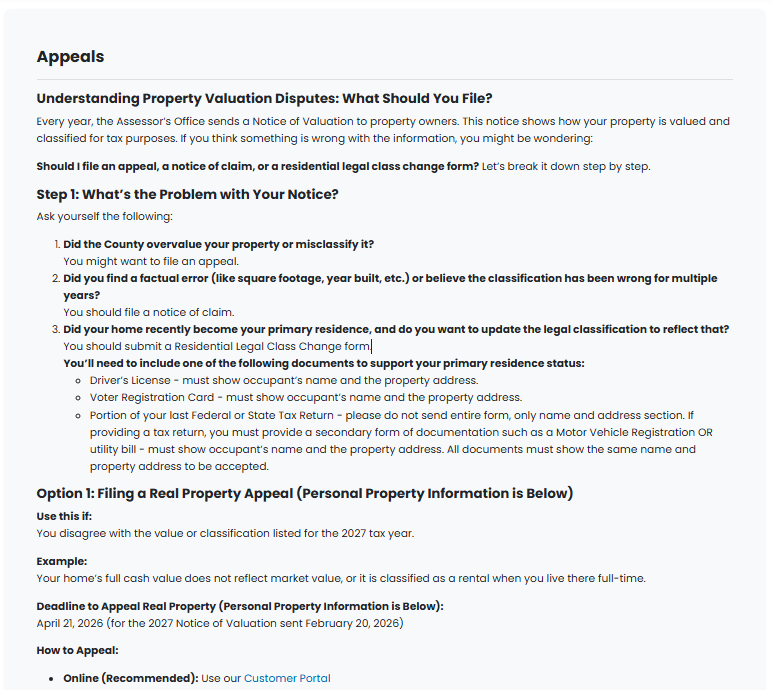
- Recent assessment rises that do not match nearby home sales
- Errors in property details, like square footage or lot size
- Damage or depreciation not reflected in records
- Comparable homes are selling for less than the assessed value
- Incorrect property classification or structure data
The appeal process works best when started soon after the valuation notice arrives. Maricopa County sets strict deadlines, so timing plays a direct role in case acceptance.
Required Documents for Valuation Appeal
Strong documentation supports a tax correction request and helps dispute valuation figures. The Maricopa County Assessor reviews only submitted records, so completeness matters.
Common required items include:
- Copy of the property tax notice or valuation statement
- Recent sales data of similar homes
- Photos showing the property condition or damage
- Independent appraisal report
- Repair estimates or inspection reports
- Property record correction forms
Each document should clearly connect to the disputed valuation point. For example, photos of roof damage can support a lower structural value claim.
Steps Property Appeal Process
- Review the property record
Check property details on the assessor’s site. Focus on size, features, and classification errors. - Collect supporting proof
Gather sales comps, photos, and reports. Use recent market data from the same area. - File a formal appeal
Submit the appeal form to the Maricopa County Assessor’s office before the deadline. Attach all supporting documents. - Review stage
The assessor reviews the claim and compares the submitted evidence with internal valuation records. - Decision notice
A written decision is issued. It may show approval, partial adjustment, or denial. - Higher review option
If disagreement continues, the case can move to the next appeal level for further review.
Property Tax Relief & Exemptions
Property tax relief in Maricopa County reduces yearly tax bills for qualifying homeowners through specific exemption programs. The Maricopa County Tax Assessor’s office applies these programs based on strict eligibility rules and verified documentation. These programs focus on lowering tax pressure for seniors, disabled residents, and surviving spouses. Each category follows separate tax reduction programs, and approval depends on income, residency, and property use.
Senior Exemption Program – Property Tax Relief, Maricopa County
The senior exemption supports older homeowners who meet age and income requirements. It reduces the taxable assessed value on a primary residence.
Points include:
- Home must be the primary residence
- Applicant must meet the age threshold set by county rules
- Income limits apply each tax year
- Property must remain owner-occupied
This program falls under the property tax relief efforts of Maricopa County and helps fixed-income residents manage yearly tax burdens. The exemptions assessor’s office reviews income documents, residency proof, and ownership records before approval.
Disability Exemption Program
The disability exemption reduces property tax obligations for residents with qualifying physical or medical conditions. The reduction applies after medical verification and financial review.
Main requirements:
- Certified permanent disability status
- Primary residence ownership
- Income qualification within program limits
- Medical documentation from approved professionals
This category follows strict eligibility criteria and works as part of county tax reduction programs. The assessor’s office checks medical records, income statements, and property data before granting relief.
Widow / Widower Relief Program
The widow or widower relief program offers tax support for surviving spouses. It helps reduce financial pressure after the loss of a partner.
Common conditions:
- Legal proof of spouse’s passing
- Property held in the surviving spouse’s name
- Primary residence requirement
- Income eligibility review
This relief program connects with relief application processing at the assessor’s office. The system reviews ownership changes, estate records, and household income before approval.
Property Types Explained
Property classification in Maricopa County defines how real estate is grouped for taxation and valuation. Each category follows a structured system that impacts assessed value and tax treatment. This system is part of the broader property classification Maricopa County framework used in asset categorization and the property type system.
Residential Property
Residential property includes single-family homes, townhouses, and condominiums. These units are primarily used for living purposes. They form the largest group in county records and follow standard residential assessment rules.
Common examples:
- Single-family houses
- Condos
- Duplex units used as primary housing
Residential classification affects long-term valuation patterns based on location, size, and improvements.
Rental Property
Rental property includes homes or units used for income generation. These properties are not owner-occupied. They fall under income-producing real estate classification.
Forms:
- Long-term rental homes
- Apartment units
- Short-term rental properties
Rental classification often carries different valuation considerations compared to owner-occupied homes.
Commercial Property
Commercial property includes buildings used for business activity. These properties are evaluated based on income potential and market demand.
Examples:
- Office buildings
- Retail stores
- Warehouses
Commercial assets follow income-based valuation models tied to business performance factors.
Agricultural Property
Agricultural classification applies to land used for farming or livestock activity. These parcels often receive special valuation treatment based on land use.
Examples:
- Crop fields
- Ranch land
- Dairy farms
This category focuses on land productivity rather than market resale value.
Mobile Homes
Mobile homes are treated as personal property or real property depending on installation status. They are tracked separately within county records.
Types include:
- Permanently affixed mobile homes
- Moveable manufactured housing
Classification depends on land attachment and ownership structure.
How Taxes Are Calculated
Property tax in Maricopa County follows a structured system tied to valuation, tax rates, and district funding needs. The Maricopa County property tax system uses assessed values, tax levy decisions, and mill rate calculations to determine yearly tax bills.
Assessed Value and Its Role
Assessed value represents the taxable portion of a property’s full value. The county assigns this value using a fixed assessment ratio applied to market estimates.
Formula concept:
- Market value × assessment ratio = assessed value
This value forms the base for tax calculations.
Tax Rate Role
The assessor does not set tax rates. Rates come from taxing authorities such as cities, schools, and special districts. These rates reflect funding requirements set through budgets.
Point:
- Assessor values property
- Taxing bodies set rates
This separation keeps valuation and taxation functions independent.
Tax Districts and Levy System
Property taxes depend on the tax districts where a property is located. Each district applies its own tax levy, which funds services like schools, roads, and public safety.
Common district types:
- School districts
- Fire districts
- City or town districts
- Special service districts
Each district contributes a portion of the total tax rate.
Mill Rate Concept
Tax rates are expressed as mill rates. One mill equals one dollar per $1,000 of assessed value.
Example:
- 10 mills = $10 per $1,000 assessed value
Mill rates vary by district combination.
Example Calculation
A sample property tax calculation follows this structure:
- Market value: $400,000
- Assessment ratio: 10%
- Assessed value: $40,000
- Combined mill rate: 12 mills
Steps:
- Convert market value into assessed value
- Apply the mill rate
- Calculate tax amount
Final tax:
- $40,000 ÷ 1,000 × 12 = $480 yearly tax
This method reflects how multiple districts combine into a single tax bill. The system depends on valuation accuracy, district budgets, and rate combinations rather than a single fixed tax figure.
Contact & Office Information
The Maricopa County Tax Assessor’s office provides direct help for property records, valuation questions, and exemption support. Homeowners and property owners can reach the office by phone or visit the main location in Phoenix for in-person assistance. For the Maricopa County assessor contact, the office offers multiple support channels so property tax concerns, parcel updates, and assessment questions get handled quickly and clearly.
Maricopa County Assessor Contact Phone & Office Location
The main contact point for the Assessor’s Office connects residents with trained staff who handle property valuation and record inquiries.
- Phone: (602) 506-3406
- Main Office Address: 301 W Jefferson St, Phoenix, AZ 85003
- Office Type: County government administration center
- Service Area: All Maricopa County property parcels
Walk-in visitors can speak with staff about tax records, ownership details, and assessment notices. Phone support works for quick questions about parcel numbers and valuation status.
(FAQs) About the Maricopa County Tax Assessor
The Maricopa County Tax Assessor manages property valuation records that are used to calculate property taxes across the county. Homeowners rely on this office for property tax questions, valuation help, and accurate assessment details that directly affect yearly tax bills. The office focuses on determining property values, maintaining records, and updating classification data used in the tax system.
What does Maricopa County tax assessor do?
The Maricopa County Tax Assessor determines the value of real property for taxation purposes across the county. It maintains updated records for residential, commercial, and land properties to support fair assessment. The office sets Full Cash Value (FCV) and Limited Property Value (LPV), which are key figures used in tax calculations. It also updates ownership records, property characteristics, and classification details based on verified data. The assessor does not collect taxes but provides the valuation data used by the Treasurer for billing.
How is home value calculated?
Home value is calculated using a mix of market activity and property-specific details. The assessor reviews recent sales of similar homes in the same area to estimate fair market value. Factors such as home size, lot dimensions, condition, location, and upgrades play a major role in the final assessment. Renovations or additions can raise the value, while aging or damage may reduce it. The final figure reflects estimated market behavior as of a set valuation date used for tax purposes.
How to appeal property value?
A property owner can appeal the assessed value if it appears incorrect or higher than expected. The process starts by reviewing the assessment notice and checking comparable property sales in the area. Supporting documents such as photos, repair records, or recent sale data can strengthen the appeal. The appeal must be submitted within the official deadline set by the assessor’s office. After submission, the case is reviewed and may proceed to a hearing for final decision.
What are FCV and LPV?
FCV stands for Full Cash Value, which represents the estimated market value of a property based on current conditions. LPV stands for Limited Property Value, which is used to control how much taxable value can increase each year. FCV changes with market trends, sales activity, and property conditions, while LPV follows a capped growth system to stabilize tax increases. LPV is often the value used for calculating property taxes, helping reduce sudden spikes in tax bills. Both values work together in the property tax system.
Why did my property value increase?
Property values can increase due to rising home prices in the local market and recent sales of nearby properties. Upgrades such as remodeling, additions, or structural improvements can also raise assessed value. The assessor may update values based on new market data or annual reassessment models. Changes in neighborhood demand and housing trends can also influence valuation increases. These factors combined reflect current market conditions that affect property assessments.