
The Maricopa County medical examiner plays a central role in official death investigation cases across Maricopa County, Arizona, where deaths require legal and medical review. This office examines sudden, unexplained, violent, or suspicious deaths and applies structured forensic science methods to establish accurate findings. It performs autopsies, toxicology screening, and medical record analysis to build complete case reports. These forensic reports become part of legal documentation used by courts, law enforcement agencies, and public record systems. The office also works with investigative units to confirm identification and clarify medical conditions linked to death cases. Each case follows a standardized medicolegal process to maintain accuracy, transparency, and consistent reporting for families, attorneys, and official agencies.
The Maricopa County Medical Examiner System supports accurate death investigation by combining pathology, laboratory science, and scene evidence review into a single structured process. It exists to provide unbiased medical findings for cases that fall under county jurisdiction, especially when the cause of death is unclear or requires legal confirmation. Forensic pathologists examine internal and external findings, while toxicology testing identifies substances that may contribute to death outcomes. The office also maintains official records that support public health data tracking and legal documentation requirements. Families, legal professionals, and government agencies rely on these findings for case resolution, insurance verification, and judicial proceedings involving forensic reports and certified death records.
What is the Maricopa County Medical Examiner?
The Maricopa County Medical Examiner handles official death investigations for cases involving sudden, unexplained, or suspicious deaths. This office determines the cause and manner of death using medical and scientific evaluation. It also produces forensic reports that support law enforcement, families, and legal proceedings. These findings help bring clarity to complex death investigation cases across Maricopa County.
Legal Authority and Role in Death Investigation
The Medical Examiner operates under county and state legal authority. The office investigates deaths that fall outside natural or expected medical circumstances. These cases often include trauma, violence, or unclear medical history. Certified forensic pathologists perform autopsies and review medical records, scene details, and laboratory results.
Responsibilities include:
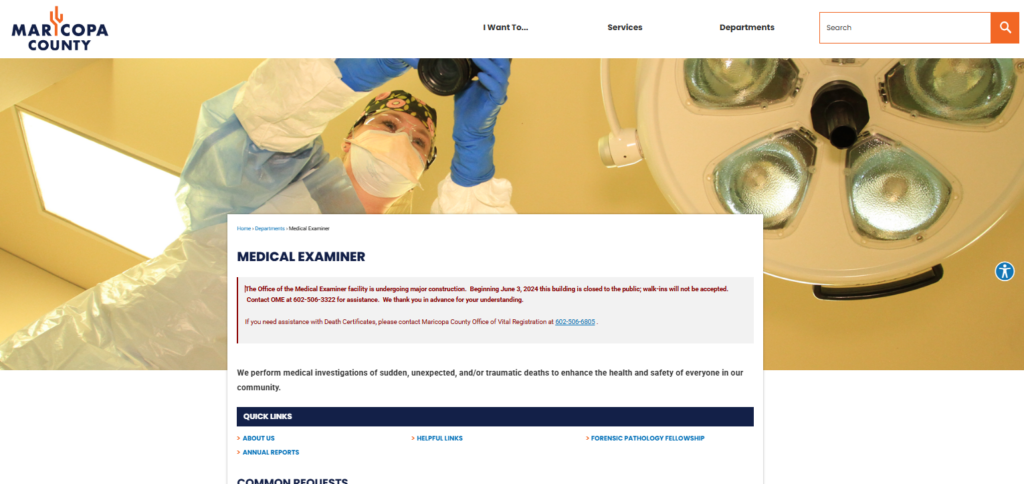
- https://www.maricopa.gov/468/Medical-Examiner
- Determining the cause of death
- Determining the manner of death: natural, accident, suicide, homicide, or undetermined
- Performing autopsies and external examinations
- Collecting toxicology and tissue samples
- Issuing official forensic reports
Law enforcement agencies rely on these findings for criminal investigations. Courts also use these reports as evidence in legal cases. Families receive certified death records that explain medical findings in formal language.
Medical Examiner vs Coroner’s Office Comparison
Maricopa County uses a Medical Examiner system, which differs from a traditional coroner office model found in some regions. A coroner’s office may involve elected officials without medical training. In contrast, the Medical Examiner is a licensed forensic pathologist with medical expertise.
| Feature | Medical Examiner | Coroner Office |
|---|---|---|
| Leadership | Forensic pathologist (MD) | Elected or appointed official |
| Training | Medical + forensic science | May vary, not always medical |
| Autopsy work | Conducted by specialists | May be outsourced |
| Focus | Scientific death investigation | Administrative review |
This structure supports more detailed medical analysis in complex cases. It also strengthens consistency in forensic findings across investigations.
When a Death Is Sent to the Medical Examiner
A death is sent to the Maricopa County Medical Examiner when it meets specific legal criteria that require an official death investigation. These cases involve situations where the cause or manner of death is unclear, sudden, or linked to public safety concerns. The medical examiner reviews these cases to determine the cause of death and document findings for legal and public record purposes.
Legal criteria for Maricopa County Medical Examiner referral
A case enters the Maricopa County Medical Examiner system when it meets statutory reporting rules under Arizona law. These rules help identify deaths that cannot be certified by a private physician.
Common legal triggers include:
- Death appears unexpected or unexplained
- No attending physician can certify the cause of death
- Death occurs within 24 hours of hospital admission without diagnosis
- Possible foul play or criminal involvement
- Injury linked to accident, trauma, or violence
- Death in custody, jail, or law enforcement setting
- Suspected suicide or overdose
- Public health concern or unusual pattern of death
Each case enters a formal death investigation process. Investigators collect scene details, medical history, and witness statements. Autopsy decisions depend on case facts and legal standards.
Types of cases handled in a death investigation
The Maricopa County Medical Examiner handles a wide range of cases involving sudden or unclear death. Each case type follows structured evaluation steps to determine the manner of death.
Common case categories include:
- Violent deaths, such as homicide or assault
- Accidental deaths like falls, traffic collisions, or workplace injuries
- Sudden natural deaths without medical explanation
- Drug-related deaths involving overdose or toxic exposure
- Suicide cases requiring forensic review
- Decomposed or unidentified remains
- Deaths in custody or institutional settings
| Case Type | Common Trigger | Investigation Focus |
|---|---|---|
| Violent | Injury, assault | Trauma pattern, evidence review |
| Accidental | Crash, fall | Scene reconstruction |
| Natural sudden | No prior illness | Medical history review |
| Toxicology | Drugs, chemicals | Lab testing |
| Unidentified | Unknown identity | DNA, dental records |
Each death investigation may involve an autopsy, toxicology testing, and forensic imaging. Findings help determine the cause and manner of death for official records and legal use.
How the Death Investigation Process Works
A death investigation in Maricopa County follows a structured medicolegal process to determine cause and manner of death. The Maricopa County Medical Examiner uses scene evidence, medical history, and laboratory testing to produce detailed forensic reports. This process supports families, law enforcement, and public health agencies with clear findings based on scientific examination and documentation.
Scene Investigation
The death investigation process often begins at the scene. A medicolegal investigator or forensic specialist responds to collect initial facts. The goal is to document conditions exactly as found.
Actions at the scene include:
- Recording body position and surroundings
- Taking photographs of injuries or objects
- Collecting potential evidence items
- Interviewing witnesses or first responders
- Noting environmental factors such as temperature
These observations support later forensic interpretation. Scene details help establish the possible time of death and events leading up to death. In many cases, early findings influence whether a full autopsy process is required.
Medical Records Review
After the scene work, the Medical Examiner’s office reviews the medical history. This step helps build context around the deceased person’s health status before death.
Records reviewed often include:
- Hospital charts and emergency visits
- Primary care physician notes
- Prescription history
- Known chronic illnesses
- Mental health treatment records
These records help connect pre-existing conditions with possible causes of death. For example, heart disease, diabetes, or respiratory illness may explain sudden collapse or natural death.
Autopsy Decision
The autopsy decision depends on multiple factors reviewed by forensic pathologists. Not every case requires a full internal examination. The decision follows legal and medical standards.
Situations that may lead to an autopsy include:
- Sudden or unexpected death
- Suspected trauma or injury
- Possible overdose or poisoning
- Unknown cause of death
- Public safety concerns
The autopsy process involves a detailed external and internal examination of the body. Organs are inspected for disease, injury, or abnormalities. Tissue samples may be collected for further testing.
Toxicology Testing
Toxicology testing plays a major role in many death investigation cases. It detects drugs, alcohol, poisons, and chemical substances in the body.
Samples commonly collected include:
- Blood
- Urine
- Vitreous fluid from the eye
- Tissue samples from organs
These samples are analyzed in a forensic laboratory. Results help identify overdose cases, poisoning, or medication interactions.
Autopsies and Examination Types
Autopsies at the Maricopa County Medical Examiner’s Office determine cause and manner of death through structured postmortem work. Each case receives a specific examination level, and findings become part of official forensic reports. Families and legal teams may later request autopsy records from Maricopa County for documentation and review. Three main examination types are used: external examination, partial autopsy, and full autopsy. Each type reflects how much internal review is required for the case.
External Examination
An external examination focuses only on visible findings without opening the body. The medical examiner records physical condition, injuries, and identifying features in detail for case documentation. This method often applies when medical history already points to a clear cause of death or when no signs of suspicious activity appear at the scene. Staff document scars, wounds, tattoos, medical devices, and personal items. Photographs support written notes, and all findings are added to official case files used in forensic reports. Toxicology samples may still be collected even without internal examination. This type of review often appears in autopsy records in Maricopa County when families need confirmation of basic findings rather than deep internal analysis. It supports accurate death certification while keeping the process limited to external observation.
Partial Autopsy
A partial autopsy involves limited internal examination focused on specific organs or systems. The medical examiner selects areas based on the suspected cause of death or medical history. This method balances detailed investigation with limited dissection. It supports cases where a full autopsy may not be required, but internal review is still needed.
Common focus areas include:
- Heart and cardiovascular system
- Brain examination for stroke or trauma
- Lungs for disease or injury
- Liver and kidney function review
Tissue samples may be collected for lab testing. Toxicology screening often supports these findings. Results become part of official forensic reports used in legal and medical review.
Full Autopsy
A full autopsy includes a complete external and internal examination of the body. This method is used in cases involving sudden, unexplained, or legally sensitive deaths where full clarity is required. The process begins with full external documentation, followed by internal examination of all major organs, including the heart, brain, lungs, liver, and kidneys. Each organ is checked for disease, injury, or structural changes that may explain death. Laboratory testing plays a major role, with samples sent for toxicology, histology, and chemical analysis to detect drugs, poisons, infections, or hidden medical conditions. Findings are compiled into detailed forensic reports that support court cases, criminal investigations, and insurance reviews. Families requesting autopsy records from Maricopa County after a full autopsy often receive extensive documentation that includes lab results, examiner notes, and final cause of death conclusions. This level of examination provides the most complete record of all death investigation methods used by the office.
How to Access Autopsy Records in Maricopa County
Autopsy records in Maricopa County come from the Maricopa County Medical Examiner after a death investigation is completed. These records include detailed forensic findings, toxicology results, and cause-of-death reports. Requesting autopsy records from Maricopa County requires a formal request submitted to the Medical Examiner’s office with proper eligibility verification and case details.
Request Process for Autopsy Records, Maricopa County
The Maricopa County Office of the Medical Examiner releases forensic reports after investigations close. Each request follows a structured intake system that verifies case eligibility and requester identity.
Requests usually include:
- Full name of the deceased
- Date of death
- Case or report number
- Relationship to the deceased
- Reason for request
Requests may be submitted through written forms, email channels, or in-person submission at the Medical Examiner’s office. Case review staff process each request in the order received.
Who Can Request Autopsy Records
Eligibility for autopsy records in Maricopa County depends on legal standing and relationship to the deceased.
Common eligible requesters include:
- Immediate family members
- Legal representatives of the estate
- Law enforcement agencies
- Insurance companies with valid claim involvement
- Court-authorized individuals
Public records laws allow some portions of forensic reports to be released after redactions. Sensitive details may remain restricted if tied to active investigations or privacy protections.
Fees and Processing Timelines
Fees depend on report length, copies requested, and certification type. Basic case summaries may have lower costs compared to full autopsy files with imaging and toxicology data.
Typical fee structure:
| Report Type | Typical Cost Range | Notes |
|---|---|---|
| Case Summary | Low fee | Basic cause-of-death details |
| Full Autopsy Report | Moderate fee | Includes pathology findings |
| Certified Copy | Higher fee | Official legal format |
| Toxicology Report | Additional fee | Lab analysis results |
Processing times vary based on case complexity. Straightforward reports may take a few days. Cases requiring final toxicology results may take several weeks before release.
Digital vs Physical Report Delivery
The Maricopa County Medical Examiner provides forensic reports in both digital and physical formats, depending on requester preference and office policy.
Digital reports
- Delivered through email or secure download links
- Faster delivery time
- Common for standard case summaries
- Easier for storage and sharing
Physical reports
- Printed documents mailed or picked up
- Includes certified stamps when required
- Preferred for legal filings or court use
- May include a full packet with attachments
Some requests may receive both formats if certification and standard copies are requested together.
Case Status Search and Online Tools
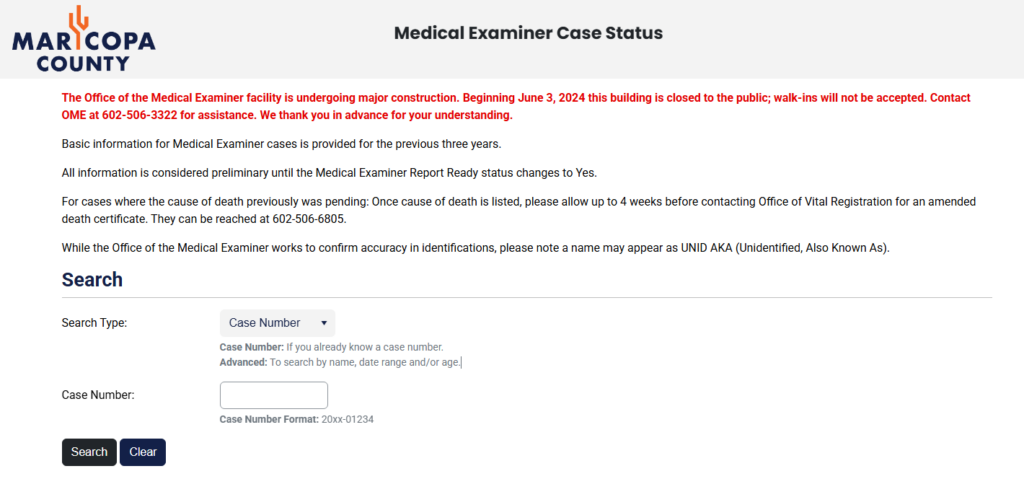
Maricopa County Medical Examiner provides an online case status search system that shows updates on death investigation cases. The tool helps track whether a case remains pending or has moved to completed review. The system supports public-facing case tracking tied to forensic and medicolegal reporting in Maricopa County.
Case lookup system and records
The Maricopa County Medical Examiner’s case lookup system displays structured case data linked to death investigation files. It reflects findings from forensic pathology review and administrative processing within the office.
The search system commonly presents:
- https://omecasestatus.maricopa.gov/
- Case number linked to each investigation
- Decedent identification details when released
- Current investigation status updates
- Autopsy report progress indicators
- Case classification tied to manner of death review
- Next-of-kin notification stage indicators
This case status tool supports transparency in medicolegal investigation records. It helps track how each death investigation progresses from intake through forensic examination and reporting stages.
Pending vs completed cases status
Case status in the Maricopa County Medical Examiner system usually falls into two main categories: pending and completed. Each status reflects a different stage in the death investigation workflow. Pending cases remain under active forensic review. Completed cases show finalized results after full examination and report filing.
Pending cases often include:
- Toxicology testing is still in progress
- Autopsy examination not fully finalized
- Cause and manner of death not confirmed
Completed cases often include:
- Final cause and manner of death recorded
- Official reports filed in the system
- Case marked closed for review activity
| Status | Description | Typical Update Stage |
|---|---|---|
| Pending | Active examination ongoing | Laboratory and pathology review |
| Completed | Final review finished | Report issued and recorded |
The Maricopa County Medical Examiner updates case status as findings progress through forensic evaluation stages. This structured system helps reflect the full timeline of each death investigation from examination to final reporting.
Death Certificates and Vital Records Process
A death certificate is an official legal record of a person’s death. A Medical Examiner report explains findings from a death investigation and may include medical and forensic details. Both documents serve different purposes in Maricopa County cases handled by the medical examiner’s office.
Difference Between ME Report and Death Certificate
The Maricopa County Medical Examiner produces reports after an examination of a deceased person. These reports focus on the cause of death, the manner of death, and supporting findings from forensic reports. A death certificate is issued for legal registration and civil use.
Differences include:
- Death Certificate
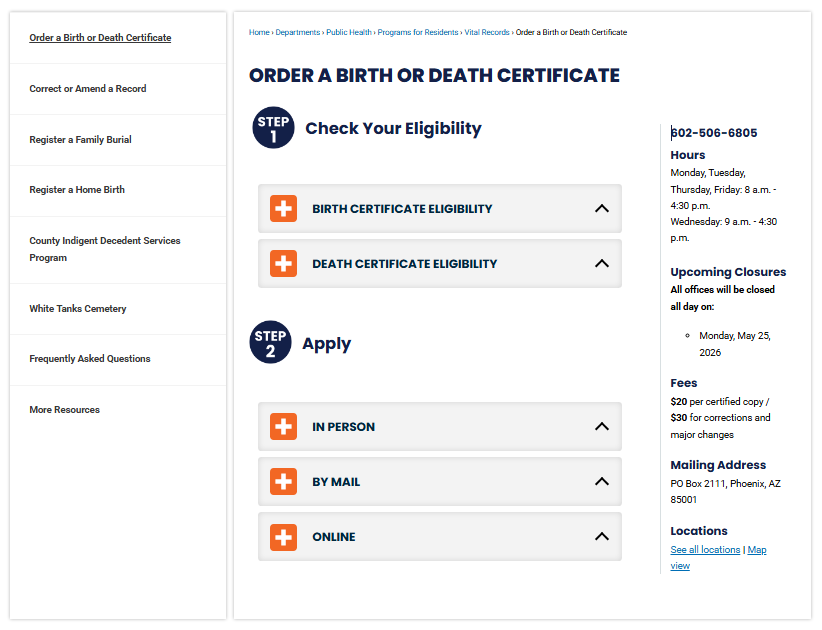
- https://www.maricopa.gov/5995/Order-a-Birth-or-Death-Certificate
- Used for legal identification of death
- Needed for insurance, estate, and banking matters
- Filed with the state vital records office
- Medical Examiner Report
- Based on autopsy or external examination
- Includes toxicology findings
- Focuses on the death investigation results
- Used by law enforcement or legal teams
Families often notice that both documents do not match in detail level. The certificate stays brief. The ME report contains full medical findings.
Where to Request Official Documents
Official documents from Maricopa County can be requested through different agencies based on the record type.
- Death Certificates
- Arizona Department of Health Services – Vital Records
- Local county health departments
- Medical Examiner Reports
- Maricopa County Office of the Medical Examiner
- Request submitted with case details such as name and date of death
Processing times vary. Some cases take longer when toxicology or forensic review remains pending.
Common Use Cases for These Records
These documents support several legal and personal needs:
- Estate settlement and probate matters
- Insurance claims processing
- Law enforcement case review
- Family closure and record keeping
The forensic reports from the medical examiner provide deeper clarity in unclear or sudden deaths. This supports accurate public records and legal transparency.
Family Support and Communication Services
The Maricopa County Medical Examiner’s office provides structured communication support for families after a death. Families receive updates, case details, and emotional assistance during the reporting period.
Family Advocate Role
A family advocate serves as a communication link between the office and relatives. This role focuses on clear updates about the death investigation process and timelines.
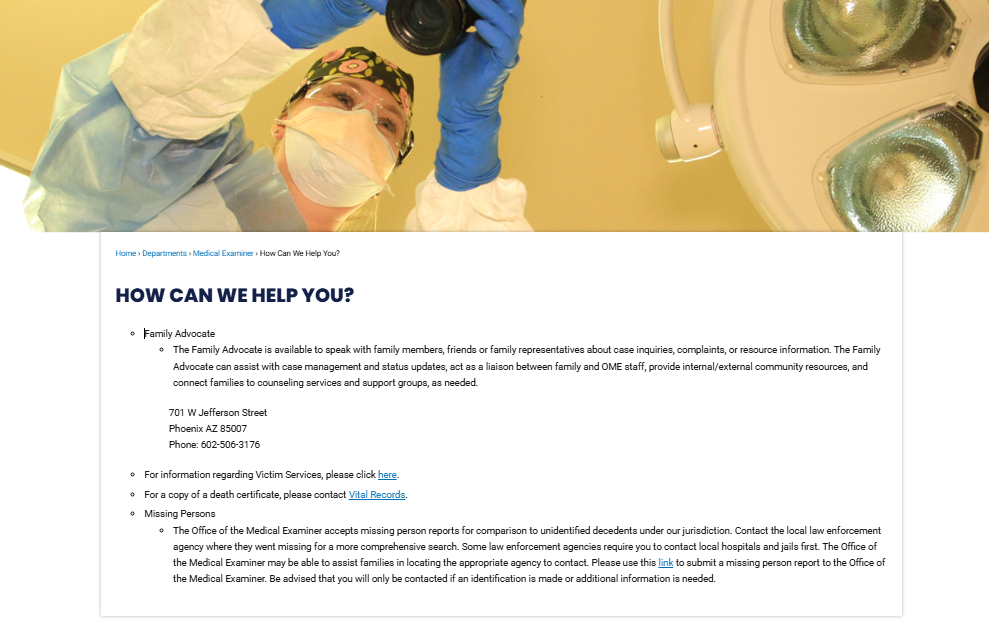
Family advocate services may include:
- https://www.maricopa.gov/5024/How-Can-We-Help-You
- Case status updates
- Explanation of autopsy steps
- Release information for the remains
- Coordination for document requests
Families often rely on this role during sensitive periods. Clear communication reduces confusion about forensic procedures and timelines.
Missing Person Coordination
The maricopa county medical examiner office works with law enforcement in missing person cases. When remains are unidentified, coordination continues until identification is confirmed.
Coordination steps include:
- DNA comparison with national databases
- Dental record matching
- Fingerprint verification
- Collaboration with police missing persons units
This process supports identification in both recent and long-term missing person cases. Each step relies on structured forensic review and case matching systems.
Emotional Support Systems for Families
Families often face emotional strain after a sudden loss. Support services focus on communication and connection with external resources.
Support areas include:
- Referral to grief counseling services
- Information on local support groups
- Clear updates on case progress
- Assistance with the next procedural steps
Staff members handle sensitive communication with respect for family needs. The focus remains on clarity, steady updates, and respectful handling of all forensic reports linked to the case.
Public Health and Safety Role of the Medical Examiner
The Maricopa County Medical Examiner’s office supports public health through systematic review of deaths. Each death investigation contributes to broader safety data used by health and law enforcement agencies.
Data Collection from Death Investigations
The office collects detailed data from examined cases. This includes cause of death, contributing factors, and environmental or medical conditions.
Collected data often includes:
- Toxicology findings
- Injury patterns
- Disease-related deaths
- Substance-related cases
This structured information builds a detailed record of mortality trends in the county.
Public Health Insights
Patterns found in forensic reports help identify health risks in the community. Sudden increases in certain causes of death can signal wider issues.
Examples of insights include:
- Drug overdose trends
- Heat-related fatalities
- Infectious disease tracking
- Injury pattern monitoring
Health departments may use this data to adjust prevention programs and public safety messaging.
Prevention Role in Community Safety
Findings from the medical examiner support prevention planning. Law enforcement and health agencies use these records to reduce preventable deaths.
Prevention outcomes include:
- Early warning on overdose spikes
- Safety improvements in public spaces
- Improved emergency response planning
- Better resource allocation for health risks
Each death investigation contributes to a growing dataset that supports safer community planning and improved public health response.
FAQs About Medical Examiner Maricopa County, AZ
A case goes to the Medical Examiner in Maricopa County when the cause or manner of death is unclear or requires legal and medical review. Families often have questions about autopsy timing, reports, and pending investigations handled through the coroner’s office and forensic team. These cases are reviewed using medical evidence, scene findings, and laboratory testing before final certification.
Why was the case sent to the Medical Examiner?
A case is sent when death happens under unclear or unusual conditions. This includes sudden deaths, trauma, or situations without a treating physician. Law enforcement may also refer cases for independent review. The office evaluates medical history, scene reports, and initial findings. Some cases require full autopsy, while others need only external examination.
How long does an autopsy take in Maricopa County?
An autopsy is usually completed within one to three business days after the case arrives. However, final results take longer due to lab testing. Toxicology and tissue analysis often require several weeks. Most forensic reports are finalized in about 6 to 12 weeks. Complex cases may take additional time depending on findings.
How to request autopsy records in Maricopa County?
Requests for autopsy records from Maricopa County are processed through the Medical Examiner’s records unit. Authorized persons, such as next of kin or legal representatives, can submit a written request. Identification and case details are required for processing. Reports may include autopsy findings, toxicology results, and investigation summaries. Fees and processing time may vary based on case status.
What is a pending case?
A pending case means the investigation is still active and not finalized. The Medical Examiner has not issued the final cause or manner of death. This often happens when toxicology results or lab tests are still in progress. It may also occur when additional review is needed. Once all findings are complete, the case is officially closed and certified.
How are autopsy findings determined in Maricopa County?
Autopsy findings are determined through a structured medical and forensic process carried out by the Medical Examiner’s office. A forensic pathologist reviews the body, scene information, and medical history to identify the cause and manner of death. This may include internal examination, toxicology screening, and laboratory testing. Findings are then combined into official forensic reports that explain what happened and why. These reports are reviewed for accuracy before release as part of autopsy records of Maricopa County. In some cases, additional expert consultation is used to confirm complex results before final certification.